We have now introduced Site Licences. For details of pricing see the individual products.
Penfriend XL Version 4.1
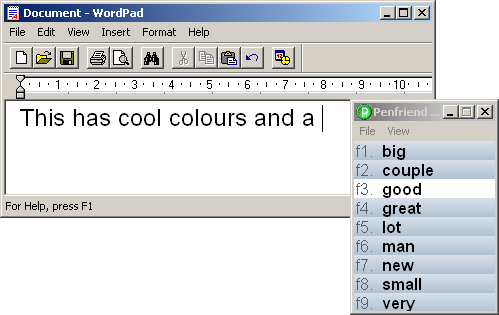
Penfriend is delighted to announce that Version 4.1 is ready to download. Penfriend 4.1 offers new innovative features including:
• A Homophone option in the prediction window to support literacy
• Type on hover to help mobility for the on-screen keyboard
• Speak on hover to support typing with the on-screen keyboard
• A transparency option so you can see all your desktop Windows and icons when Penfriend is running and discretely use Penfriend without anyone knowing!
If you already have Penfriend XL version 4 then you can download the update for free via the website link in the copy of your program.
Homophone Support
Homophones, sometimes known as ‘confusables’, are words which have a similar sound but differ in spelling and meaning. Examples of homophones include ‘there’ and ‘their’, ‘where’ and ‘were’ and so on.
Confusable word hints
With over 400 homophones in the English language, similar sounding words add depth to a language but they can also be the cause of great frustration. Spell checkers can’t be relied upon where these troublesome homophones are concerned. Confusables are often highlighted by people who experience dyslexia as a source of annoyance and confusion as you could accidentally end up with a properly spelled word, but the wrong word!
With Penfriend’s new option ‘Confusable word hints’ (go to View and Preferences) you can now see and even hear the difference between confusable words, so there’s no excuse to get ‘pair’ and ‘pear’ or ‘bear’ and ‘bare’ mixed up anymore.Abbreviation Expansion Now accepts unlimited length and number of abbreviations. Up to 12 can be displayed at one time.
Major expansion to the possibilities with abbreviation expansion.
Below is an example of how Abbreviations can now be used. – Here a disabled person is using abbreviations to communicate with a carer. By typing one abbreviation tv up to 12 related expansions can be shown and either entered into a document or spoken. Here by typing tv they have 12 requests to a carer for help with the TV. Below is abbreviation window when the 12 abbreviations have been created.
When they then type ‘tv’ in their document, the 12 instructions all appear in the predictor window. Note that tv does not appear as it has been banned in the lexicon.
If they have set Penfriend to speak on a right click then the phrase they want will be spoken when they click on it.
The same system can be used for common phrases, email addresses, URLs, postal addresses, to be read, entered or both. In English one could use qa, qb, qc as abbreviations as there are no words beginning with these combinations. So you could use qa as the abbreviation for 12 addresses. If qa is banned then it will not appear.
In French there are virtually no words starting with ‘k’ so ka, kb etc can be used for sets of 12 abbreviations.
On-Screen Keyboard
Penfriend’s on-screen keyboard has always been a favourite feature with our customers, particularly those who use an alternative mouse such as a trackerball. We have now introduced 'Type on hover' to help mobility and 'Speak on hover' to support typing with the on-screen keyboard, offering increased accessibility and usability to our customers.
In Version 4.1 we improved the on-screen keyboard which now has an option to allows individual letters and function keys to be echoed or read back.
This is a particularly useful feature for individuals who are leaning to type such as early years or even those who are new to a computer and are learning to type. Speech feedback on the on-screen keyboard is also very beneficial to those who are struggling with literacy and require audio feedback to help scaffold their learning.
Transparency feature
And for those of you who’d rather be discrete about using Penfriend we’ve included a new transparent feature which means you can still see all your desktop windows and icons when Penfriend is running and you can use your favourite assistive technology without anyone else knowing….but you!
Penfriend's suite of literacy tools
When was the last time you looked at Penfriend? Penfriend features a comprehensive suite of literacy tools and so much more! Penfriend can support people of all abilities and ages.
If you have a literacy difficulty such as dyslexia then Penfriend can help with spelling and grammar. As well as predicting words when you type, Penfriend will read text aloud from websites, documents, in fact any Windows text-based program.
The Penfriend Blog
With the release of the new Penfriend Blog there are now video tutorials to get you up and running with Penfriend in no time at all. And if you’d like to keep up-to-date with what’s happening at Penfriend then you can follow us on Facebook and Twitter.

Who can Penfriend benefit?
Penfriend software benefits users who have dyslexia, visual impairment or physical disablilities, including Cerebral Palsy, Multiple Sclerosis, Motor Neurone Disease, Stroke, limb deformities and any condition which impairs the ability to write with a keyboard.
Penfriend helps users to write faster by predicting the next word they want to type, allowing faster writing for longer tasks, promoting better spelling and grammar and encouraging users to overcome low self esteem and become more confident writers.
Features include powerful word prediction, on-screen keyboard, screen reading, lexicon editing and the ability to learn new words as you type.
Penfriend Products
- Screen reading and text magnification.
- Word prediction in many languages.
- On-screen keyboards for many languages.
- Modern Foreign Languages (MFL).
- English as a Second Language (ESL).
- Integrates with Clicker 5.2
- High quality Cereproc Voices.
- Word prediction.
- On-screen keyboard.
- Speech feedback.
- English as a Second Language (ESL).
- Learning of new words
- Integrates with Clicker 5.2
- Penfriend Portable comes on a USB memory stick.
- No installation required.
- Can be used on many computers.
- Versions of all Penfriend products are available as "Portables".
- High quality Cereproc Voices.